
I’m heading out on a weekend retreat with our youth group. Please pray for me.
Here’s a little design I worked up for our retreat:
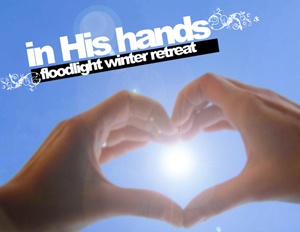
* * * * *
If I’m not back by Sunday evening, please send a team into the woods looking for me.
I’m heading out on a weekend retreat with our youth group. Please pray for me.
Here’s a little design I worked up for our retreat:
* * * * *
If I’m not back by Sunday evening, please send a team into the woods looking for me.
Thank you, everyone, for your prayers. I think they might be the one thing sustaining us right now.
I am writing from Orange County. My wife is an amazing trooper — she drove most of the four-hour drive through bumper-to-bumper traffic up from San Diego, while I spent most of the trip vomiting (we think it was probably due to smoke inhalation). Our family is still safe, but all we have right now is what we could cram into the car during the mad dash to evacuate our place. We are hearing reports that our apartment is still standing, but at literally the next stop light up the road the fire departement is not allowing people to pass because of the continuing fire danger.
We spent most of yesterday at church helping out church families who were, and still are, under mandatory evacuation from their Rancho Bernardo homes. Just to give you an idea of the sheer destructive force of these fires, here is the preliminary report of homes lost in the Rancho Bernardo neighborhood alone (although, because so many residents have been trying to access the site, you might want to wait a couple of days before checking it out so that there is more bandwidth for those affected).
There are wildfires raging in Orange County as well, which is what brought us to my father-in-law’s place. If they need to evacuate (which is still a realistic possibility), then we wanted to be available to help them. Things seem relatively stable here, so if we get word that we can return to our homes then we will be back in SD tomorrow.
Our students are frightened. I can’t tell you how many of them received phone calls from their friends, weeping because they had already lost their homes. One of my ninth-graders, in fact, was the first one to inform her friend that she had lost her home after seeing their address listed during the continuous television coverage. How do you deal with that? We prayed together and tried our best, with racing hearts, to reassure and comfort them.
Worse still, many of them live in the neighborhoods that were hit hardest. One of my youth group teachers left her house with only her family and the clothes on their back when the police arrived at their house at four in the morning, urgently telling them to evacuate because the fire was already destroying their neighborhood.
We’re still waiting to find out which homes are still standing. It’s the not knowing that is the worst part. Yes, yes — it’s just stuff; but, at the same time, these homes are safe havens filled with memories and it has been utterly crushing to just sit and wait and watch while San Diego burns.
Over half a million people have been evacuated. There are over 20,000 people taking refuge at Qualcomm Stadium. The fires continue to rage across thousands of acres and turn countless lives upside-down. View the San Diego Tribune’s interactive map to get a sense of the vast scope of devastation in the San Diego area.
Somehow, we know that God is bigger than all of this — but, from down in the soot and ash, fear and despair, it is so hard to trust. We treasure your continued prayers for all of us here.
Being in town meant that I would not be missing our Sunday at church. While there is a definite downside to not getting away for the weekend, I could sense how God was using the words spoken through Francis Chan and Doug Fields to enlarge my heart further for my students. Maybe it was nothing revolutionary for them — I’m sure I still managed to lull them to sleep during the sermon today — but I’m praying that, by the grace of God, my love and prayers for them would ever increase.
* * * * *
 After a full day at church, I hustled over to the Town & Country and caught the Q+A part of Shane Hipps’ first seminar. I chatted briefly with him and wandered with him over to his next seminar (which turned out to be a good thing, because I never would have found the seminar room on my own. I’m really bad with maps and have managed to get lost several times this weekend) which expanded on several of the ideas in his book The Hidden Power of Electronic Culture, which I highly recommend.
One of the most important things Shane discussed was the oft-referenced idea, “The methods change but the Message stays the same.” This speaks to our efforts to adapt new ways of bringing the timeless, eternal Truth of the Gospel to different peoples and cultures. Unfortunately, though the sentiment is sincere and well-intentioned, it is also false.
As Marshall McLuhan said, “The medium is the message.” Shane did a fantastic presentation of McLuhan’s life, thoughts on media and the future and how this impacts us as followers of Christ. We must be clear-eyed about the ways in which the media we use — and not only Media Shout or MySpace — fundamentally alters the message we are trying to convey. I saw this illustrated at every general session — although I was often sitting only several yards from the speaker, I found myself (and saw most of those around me) watching the giant screens rather than the actual person in front of us. Shane gave a great quote about this: The screen always wins — it’s almost a creepy, bizarro take on “Love Wins” but it’s so true.
Although this seminar was very much about our current media culture, Shane was really addressing worldviews. And, even to take a step back further from that, Shane was addressing the forces at work that shape our worldview. Another McLuhan quote is helpful here: “We become what we behold.”
The printing press ushered in an age of linear, sequential, uniform, repeatable thinking as normative. And, in the modern world, we find this repeated in unexpected places — from the assembly line of cars and cookies, to the orderly, linear pews in our churches, to reducing the entirety of the Gospel into a sequential formula (e.g., Repentance of sins + Acceptance of Christ = Salvation to heaven).
However, the world in which we live changed long before the advent of the internet. Shane argues that the invention of the telegraph, photograph and radio began a dramatic shift in how we see the world. The telegraph, or “Victorian Internet,” broke the relationship between transportation and communication. The photograph recalls the stained glass of the Middle Ages — consider the difference between seeing the printed words, “The boy is sad” versus this photograph of a sad boy. The words are rational, linear and left-brained; the photo is intuitive, non-linear, right-brained — qualities that describe the shift toward postmodernism.
* * * * *
I will interact more in the future with some of these thoughts. Shane’s seminar today triggered quite a few thoughts that I’d like to work through — especially regarding the built-in fluidity and ability of Asian Americans to navigate between and through different cultures. He was extremely gracious in fielding all manner of questions, and taking time out to chat with me a bit before leaving to catch his flight. It was interesting to listen to the line of questions that people raised afterward — questions about doctrine, defending our faith and jumping straight to the “take-home” revealed their linear, sequential, rationalistic mindset.
* * * * *
I’m getting packed up just in case we need to clear out of here because of the wildfires raging around here. Please keep us in prayer.
I am worn out after day three of NYWC but, finally, in a good way. I always have difficulty articulating my inner life but I have been in a particular state of disorder in the weeks leading up to NYWC. In the midst of busyness and weariness, I have not been listening well for God’s voice. Today, at the convention, the fog began to lift in myriad ways. This was a full day of getting to sit under some great teaching, and Mike shared about building a holy rhythm to our lives.
* * * * *
I have been looking forward to hearing Francis Chan since I saw that he would be a main session speaker. He is a dynamic and gifted communicator — and, as an Asian American, it is so encouraging to see a face to whom I can relate up on the main stage. I am sure, though, that his words spoke to everyone there this morning. I won’t attempt to recap everything Francis said (although I’m sure I will wear out the CD of his talk that I picked up), but God was definitely speaking to me through his words this morning. Several times, I found myself in tears as I listened.
When Francis began to share his heart, as a parent, about what he wanted from his daughter’s youth pastor, I was completely convicted. More than programs and messages and the big show, he is looking for a youth pastor who will love and pray passionately for his daughter. I know I would wish the same thing for my daughter — and, if that’s what I’m looking for, then I cannot offer any less.
Francis’ words about actually believing the Bible and living it out — not mediated or filtered through someone else’s lens, but engaging, living and breathing the Word of God in real life. The consequences in the life of Francis and his church have been nothing short of revolutionary.
* * * * *
 In the afternoon, I went to a brilliant seminar by Mike King. His words gave voice to so much of that with which I have been wrestling over the last couple of years. He exhorted us to find out what makes us feel fully alive, and to incorporate those things into our everyday lives. I am looking forward to reading his book Presence-Centered Youth Ministry. He gave several practical, creative, engaging ways to incorporate a rule of life into our daily living.
In particular, his words about community spoke powerfully to me. Not just community as a concept, but the physical, proximate community of people with whom we actually live our lives. The commuter church has not been kind to our family in terms of building and maintaining these kinds of meaningful friendships — I feel my heart gravitating more & more towards this friendship and proximity.
* * * * *
Tonight’s main session was brutal in all the right ways. Doug Fields spoke about his deepening concern for the heart of youth workers and he identified ministry envy as a primary killer of our hearts. While we might be good at masking the obvious envy we have of others, it comes out in the way we talk about and criticize others. Sure, we might try to disguise the envy by claiming that we’re just pointing out our differences, but it looms large in many of our lives.
In a powerful exegesis of the Genesis account of Joseph and his brothers, Doug showed us the crippling effects of envy — and ways in which we can combat it. By celebrating others and their accomplishments we are protecting our own hearts. Celebration counters our tendency to turn those who should be colleagues and friends into rivals.
* * * * *
Doug’s words caused me to reflect more deeply about what I recently wrote about the American worship music industry. My words might have come across as an unfair attack against Matt Maher, in particular. I sincerely regret speaking quickly and foolishly. There is plenty of room for legitimate criticism when it comes to the worship industry, but I want to be much more careful with my critical words — not to speak out of envy, bitterness or cynicism. I want to spend more time celebrating those things I genuinely love and appreciate than in criticism (legitimate or not).
I missed the second half of today’s NYWC because our family went up to Disney for their annual Mickey’s Halloween Treat night. If you have the chance to go, it is lots of fun — games, crafts, dancing and, of course, tons of candy. In any case, that’s why these are my reflections from Day 2A at NYWC.
The running theme throughout the convention is “Storyline” and the YS team has done a fantastic job so far in pulling together the idea that we are all part of God’s larger meta-narrative story. I love that in the room where we meet for the general sessions, they have even played with the way we sit — kind of an “in the round” experience. I was half-expecting one of those U2 circular-type stages where Crowder could run a circuit through the crowd :)
For me, Joe Castillo’s artistic presentation of the Creation story was totally new and unexpected. I can be kind of a cultural Philistine when it comes to art, but my heart was definitely moved by his “SandStory” presentation. Joe has a SandStory video clip of the Passion on his site, which will give you an idea of what this was all about. Marquis Laughlin presented a powerful monologue from the book of Revelation — what a voice! If I had a voice like his, I would talk all day long (not that I don’t already!). I love the fact that to kick off the first general session, we were immersed in the beginning and the end, so to speak, of The Story.
* * * * *
I’m a sucker for old-school punk rock. I grew up skateboarding to Minor Threat and The Pogues, so getting to hear Flatfoot 56 for the first time today at the general session was really nice. I mean, seriously, how can a band with a bagpiper not put a smile on your face? I really appreciated the video clip in which Tic interviewed them and they had a chance to share their heart. They are reaching kids who might feel utterly rejected by the church by literally meeting them where they are — for example, opening for Irish-punk heroes Flogging Molly. I commented to the bagpiper afterward that this probably isn’t their usual crowd, but he smiled and said they knew this wouldn’t necessarily be their typical audience but that they still had lots of fun performing.
* * * * *
Dr. Brenda Salter McNeil gave a stirring talk which used The Lion King as an extended metaphor for reclaiming our identities as the people of God and our role in pointing youth back to their true heart and calling. It will probably take a couple of days to interpret the scratches and doodles I wrote in the dark in my notebook, but I will share soon about some of the great things Dr. McNeil shared about the global story in which we, and our students, find ourselves.
* * * * *
As I’ve said before, I’m a big fan of the David Crowder*Band. And, from what I could see today, it appears that so are most of the 4000 or so of us gathered here this weekend. From the opening quarter-note hoedown clapping of “Undignified” to the really green keytar and the exhortation that our singing was “pretty” but need to be much louder, it was classic Crowder — which is to say, the man really has a knack for leading groups of people into the presence of God. The Super Mario synth jam and the (somewhat frightening) video of Crowder as Mario were bonuses.
Singing “Remedy” this afternoon was particularly powerful for me. I think people who have criticized the Remedy album for being too simple have missed the point. I think David has always been an incredible lyricist — pushing the boundaries of our imaginations in corporate worship — and his skill has only grown over time. He evokes so much through so few words. Those of us in ministry (or who have suffered through the “sermon that never ends”) know that it is much more difficult to preach a meaningful short message than it is to drone on & on for an hour.
These words came to life as we sang:
Here we are / Here we are
The broken and used / Mistreated, abused
Here we are
Here You are / Here You are
The beautiful one / Who came like a Son
Here You are
So many of us in youth ministry are hurt, wounded and weary. That’s why I appreciated Marko’s words about the “holiness of wasting time” so much. We need to be honest about our brokenness, not hiding it by working even harder. But it’s not just a story of our brokenness; rather, as we view our frailty and limitations, “We lift up our voices / We lift up our hands / To cling to the love that we can’t comprehend.”
 headsparks*

