Archives for category: church

Earlier this week, my wife and I went to a meeting hosted by James Choung, to help plan for an Asian American leadership gathering in April of 2008 down here in SD. I’m definitely looking forward to hearing from the main session speakers — Dave Gibbons, Peter Cha and Ken Fong — along with those who will be presenting seminars.

During the meeting, James shared something that really struck a chord with me — voicing some thoughts that I’ve been feeling, but unable to articulate. He mentioned that, often, when we gather as Asian Americans the general ethos tends toward the negative and focuses on the weakness of being Asian American — e.g., how to overcome struggles with your first-generation parents, shame and identity etc. While these are important issues that we must continue to address, with this gathering we are hoping to shift the focus toward embracing the people God has created and redeemed us to be — to understand how deeply we have been blessed that we might be a blessing to others.

I’m trying to work out the core image for our theme, “Called Out, Called Forth.” For this draft, I’m definitely trying to create a postmodern vibe and to emphasize the high calling God has placed on us — so the theme is pushing skyward. The city represents the campuses and workplaces in which the conference participants live, study and work. And the birds represent the desire to take flight, to break free from our fear of failure. Here is the design concept (there is no actual website yet, and the location is yet to be determined but the core concept is there). Any thoughts?

city-1-draft.jpg

Last Friday, our family went to see Architecture in Helsinki perform live at the House of Blues here in San Diego. The House of Blues has a “pass the line” policy, where concertgoers can be the first in line if they dine at the HoB restaurant. Because we wanted to make sure to get seats in the balcony, we ended up having dinner there before the show (which, it turns out, was pretty good). After dinner, we jumped the line and sat front row, center in the balcony.

Unfortunately, the first two acts were a serious letdown. Panther, which is essentially just one person, a delay pedal and a bunch of blips & bloops, was kind of fun for the first two songs. I think his music is more interesting in recorded form, as seen in this video clip for You Don’t Want Yr Nails Done. At least he brought along a live drummer. Glass Candy, on the other hand, was just a boy cranking out pseudo Kool & The Gang riffs on a half-size synth and a girl aerobacising and vocalizing in between the overly plentiful stage banter.

Don’t get me wrong, I am not opposed to indie kids discovering the dance floor. I mean, look at Matt and Kim. Some criticize them for being too precious, but it’s hard to deny their enthusiasm and joy. Check out their video for Yea Yeah and see if it doesn’t brighten up your day:

Our family loves all manner of live music, but even our daughter turned to me at one point during the Glass Candy set, frowned and shrugged. All I could do was shrug back. Things turned around quickly, however, as soon as Architecture in Helsinki took the stage.

From the get-go, they brought a level of raucous joy and excellent musicianship that basically turned a bunch of motionless indie kids into Dance Party USA. Listeners are helpless to do anything except smile and dance. Our little one was a total trooper, staying awake as late as she could. She stayed long enough to hear her favorite song, Like It Or Not (or, as she calls it, “The Trumpet Song”) — a hopped-up conga-line singalong extravaganza, before we had to call it a night.

Just to pick up a thought I had started before, I really, really wish I could experience this kind of joy and freedom in our church music. Seriously, when was the last time a worship band caused you to spontaneously smile and start dancing? Architecture in Helsinki definitely has that DIY, everyone’s invited kind of indie vibe, but they are not sloppy in their execution — for being basically an ensemble band, they are extremely tight. And, because they are so good at what they do, they are free to enjoy the music and draw others into it. A nice template for our worship bands, no?

These days, it seems like a band’s image is as important as the music they create. So, it is refreshing to see a bunch of normal looking people, not particularly dressed up get up onstage and rock the set. It worries me when, on all of my worship discs, every person has radiant skin, straight teeth and perfect hair — I’m not trying to take away anything from these artists, but simply hoping that our communities are open to all kinds of people, onstage or otherwise.

As the psalmist says, “Sing the glory of his name; make his praise glorious.”

Although I know it has been a major buzzword (with all of the misuse and/or overuse that entails) in some circles, I have come to believe more & more in the missional church. To be missional, in my understanding, is more than simply “doing” mission work in faraway places as a program or department of a church; rather, it is the priesthood of all believers living and embodying the message of Christ anywhere and everywhere we go, participating in the missio dei with our whole lives. For some great insight into the missional discussion, check out Friend of Missional.

It saddens me when our pastor greets me with a big smile and a handful of glossy brochures of mega-church x’s summer mission program and urges me to set up our own ten day summer “mission” trips so that we can strengthen the faith of our young people and, of course, make our own glossy brochures. I’m not knocking these quick mission adventure trips. They really can be life-changing; but, in my experience, there is a strange paradox of people receiving the most when they go with the intention of giving the most.  So, to make the primary objective of these mission trips the personal enrichment of those who participate is to miss the point. I even enjoy designing brochures, but I remain unconvinced that we should do it simply because the big guys do it. With so much working against short-term mission trips, and even perhaps the very concept of missionaries (the tragedy of the Korean missionaries in Afghanistan this past summer highlighted this tension), it is tempting to dismiss completely the traditional paradigm of church and mission.

nepal1.jpg

However, there is definitely something to be said about the people who go to the hard places in order to share the love of God and the message of Christ. I was reminded of that today, as our family drove up to Los Angeles to see my mother-in-law. She has been on furlough from her mission work in Nepal for about a month, and is going back next week. She is over sixty years old and spends most of the year in one of the most remote places on earth, teaching orphans and bringing the kingdom. She gave me the bracelet above, which reminds me to pray for her, after returning from Nepal the first time a couple of years ago.

Certainly, missional living and traditional mission work are not mutually exclusive. In fact, I would imagine that missional people would want to live out and share the love of God in both their local community and around the world. And, by the same token, it makes no sense whatsoever for someone to go on a “mission trip” if they have no greater sense of the mission dei, that God is the one sending them.

May we become and build communities completely captured and sent by the love of God in Christ, everywhere.

As Eugene Cho wrote recently in southern california is burning, it can be hard to actually enter into another person’s experience. Even for us, right in the midst of the firestorm and its aftermath here in SD, there can be a strange disconnect. Like others around the nation, we’ve been watching the firestorm from the television. As Shane Hipps comments, “The screen always wins.” I mean, we are here and it wasn’t even a week ago that we were grabbing only the essentials as we evacuated through the smoke and sirens early in the morning and yet watching the constant news feed has a strange, dulling effect. The sense of being “informed” creates a false sense of understanding, which can easily create a barrier to actually engaging the reality of individual people’s lives.

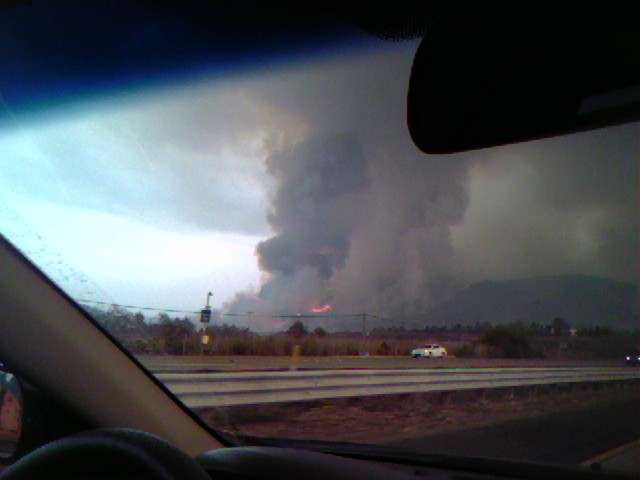
Sometimes it takes just being there to feel and understand it. During our return back to San Diego, we drove past the Camp Pendleton fires which created a menacing black cloud through which we had to drive. This junky cell phone photo (which, not to worry, were taken by my wife from the passenger seat!) shows how powerful one small brush fire can be — the hills and valleys in the immediate vicinity were, at the time, pretty well ablaze, so you can imagine what the larger scene looked like:

fire-4.jpg

* * * * *

However, more than just driving by, what brought home the impact of these fires for me was helping a church family try to deal with the aftermath. This particular family lives in one of the hard-hit neighborhoods and were just able to re-enter today. After much worrying and wondering, they were relieved to find their home in good condition. Their neighbor five houses, down, however, was not so fortunate:
five-doors-down.jpg

I have heard about the random nature of fires — one house will be perfectly fine, the next completely leveled. But it is an altogether different experience to see it with my own eyes. We spent most of the afternoon trying to clean up the ash and soot that covered most of everything and to try to make their place livable again.

On Monday, while were still greeting evacuees at our church, a stranger wandered into our education building. After talking for a bit, finding out some of his story and giving him some bus fare, he said (regarding the wildfires), “You know, people call these kinds of things ‘acts of God.'” I told him I didn’t think that was an accurate description of what was happening. As much as we’re all grateful that God has spared our homes, can we really say that we out-prayed or received more favor from God than those who lost their homes? I don’t think this is a straightforward one-to-one proposition — otherwise, we’d all end up losing our places, wouldn’t we?

* * * * *

After cleaning the front of the house and the garage, we moved to the backyard — which, if we didn’t realize it before, definitely put into perspective how close they came to losing their house. One family member saw the garden hose in the back and didn’t remember leaving it out, and then we saw this burnt out palm tree, not even ten feet from the house:

burned-palm-tree.jpg

We could only guess that either a firefighter or neighbor who stayed behind saw the burning palm tree and doused the flames with the garden hose. Just beyond the white fence is the ravine through which the fire cut a brutal path — embers kicked up from the Santa Ana winds must have caught the house five doors down.

However, the street just across the gulch was hit much harder. I passed house after house that looked as if some angry, mythic giant had just stomped on them; but there was the same randomness — one house was hit, the next three were fine, and then two in a row were gone. News crews were out in full force (I saw at least three), chronicling the heartbreak of families trying to salvage whatever they could.

next-block.jpg

* * * * *

My daughter attends the preschool of a church in this community in which 57 families lost their homes. Tonight, they hosted a gathering of worship, prayer and sharing. It did our hearts good to stand with others in our community who have lost it all and yet can say, “We are survivors; God is with us” as we did as a modified benediction today. Reading Scripture together, seeking God and interceding on behalf of others, sitting together in silence. The old hymn, “Great Is Thy Faithfulness” came together with a new resonance tonight.

We realized tonight that, in our longing for connection, community is not going to come to us — we have to pursue it, build it wherever we are. If you are in the San Diego area, there are plenty of people in need. Some need help sifting through the rubble, some might need special expertise navigating the maze of FEMA and insurance, and some might just need you to listen to their stories and weep with them. Let’s be the body of Christ to a hurting world. Or, as Donald Miller writes, followers of Christ are called to live “as if something was broken in the world and we were supposed to hold our palms against the wound.”

Thank you, everyone, for your prayers.  I think they might be the one thing sustaining us right now.  

I am writing from Orange County. My wife is an amazing trooper — she drove most of the four-hour drive through bumper-to-bumper traffic up from San Diego, while I spent most of the trip vomiting (we think it was probably due to smoke inhalation).   Our family is still safe, but all we have right now is what we could cram into the car during the mad dash to evacuate our place.  We are hearing reports that our apartment is still standing, but at literally the next stop light up the road the fire departement is not allowing people to pass because of the continuing fire danger.

We spent most of yesterday at church helping out church families who were, and still are, under mandatory evacuation from their Rancho Bernardo homes.  Just to give you an idea of the sheer destructive force of these fires,  here is the preliminary report of homes lost in the Rancho Bernardo neighborhood alone  (although, because so many residents have been trying to access the site, you might want to wait a couple of days before checking it out so that there is more bandwidth for those affected).

There are wildfires raging in Orange County as well, which is what brought us to my father-in-law’s place.  If they need to evacuate (which is still a realistic possibility), then we wanted to be available to help them.  Things seem relatively stable here, so if we get word that we can return to our homes then we will be back in SD tomorrow.

Our students are frightened.  I can’t tell you how many of them received phone calls from their friends, weeping because they had already lost their homes.  One of my ninth-graders, in fact, was the first one to inform her friend that she had lost her home after seeing their address listed during the continuous television coverage.  How do you deal with that? We prayed together and tried our best, with racing hearts, to reassure and comfort them.

Worse still, many of them live in the neighborhoods that were hit hardest.  One of my youth group teachers left her house with only her family and the clothes on their back when the police arrived at their house at four in the morning, urgently telling them to evacuate because the fire was already destroying their neighborhood. 

We’re still waiting to find out which homes are still standing.  It’s the not knowing that is the worst part.  Yes, yes — it’s just stuff; but, at the same time, these homes are safe havens filled with memories and it has been utterly crushing to just sit and wait and watch while San Diego burns. 

Over half a million people have been evacuated.  There are over 20,000 people taking refuge at Qualcomm Stadium.  The fires continue to rage across thousands of acres and turn countless lives upside-down. View the San Diego Tribune’s interactive map to get a sense of the vast scope of devastation in the San Diego area.

Somehow, we know that God is bigger than all of this — but, from down in the soot and ash, fear and despair, it is so hard to trust.  We treasure your continued prayers for all of us here.