photo

I returned recently from my second trip with Living Water International to Nicaragua to help bring clean water to a community in need. It is so humbling to be a small part of what God is doing there to demonstrate His love & care for the world.

Jorge, the team leader in Rivas, Nicaragua, told us a heartbreaking story about the reality of the water crisis. Recently, after completing a well, an elderly man from the village told Jorge he was very grateful, but that the well was two years too late. Jorge found out that the man’s wife had died two years earlier from water-related disease.

As a friend from our church community shared in his testimony this past Sunday, as we spent the week in the mud, digging and drilling for clean water, we could sense God saying to our new friends there that He has not abandoned them.  Despite the staggering statistics (almost 800 million without access to clean water, over 2 million water-related deaths each year), we know that God has not given up — and neither have we!

When the church answers the call to action, being willing to get our hands dirty so that others can live, our living sacrifice paves the way for the Living Water of Christ to flow.

Learn more about LWI’s work here:

.  .  .  .  .

Dallas Willard — author of seminal works such as The Divine Conspiracy and Renovation of the Heart — died today.

Although I did not know Dr. Willard in a personal sense, the impact of his work changed the direction of my life and ministry in ways that continue to reverberate today. Clearly, based on the outpouring of love & sorrow I’ve seen via social media streams today, many feel the same way.

My friend Steve sums this up beautifully:

Spirit Farmer

Dr. Willard opened my eyes to the ways in which we so easily distort the beautiful, wild, incredible life of loving & following Jesus Christ to become a gospel of sin managementIf I just avoid drinking/dancing/etc., then I will have fulfilled my Christian duty.

From The Great Omission:

Grace is not opposed to effort, it is opposed to earning. Earning is an attitude. Effort is an action. Grace, you know, does not just have to do with forgiveness of sins alone.

Willard’s call to live today in Christ, becoming an apprentice of His way, transformed how I viewed my everyday life. Grace is not a static theological trophy gathering dust on the shelf or a paperweight with which we can club others over the head.

Grace compels us to live.

Today, we are not only saved by grace, we are paralyzed by it. We will preach to you for an hour that you can do nothing to be saved, and then sing to you for forty-five minutes trying to get you to do something to be saved. That is confusing, to say the least.

Grace calls us to  a life infused with Christ’s resurrection life — His joy, peace, purpose, and strength:

Spiritual formation does not aim at controlling action. It is a matter of reworking all aspects of the self. It is a process that involves the transformation of the whole person, and that the whole person must be active with Christ in the work of spiritual formation.

This vision of life in Christ renewed my understanding of spiritual disciplines. We don’t pray or read our Bibles or fast to prove how “spiritual” or “mature” we are; we don’t fast as some kind of divine punishment. Rather, we are retraining our souls for a new way of life:

Spiritual disciplines are activities in our power that we engage in to enable us to do what we cannot do by direct effort.

A couple of years back, I had the chance to hear Dr. Willard speak live. It would have been easy for his words about discipleship, sin, and transformation to be heavy or burdensome. Instead, because of his winsome approach, I found his words to be freeing and pointing toward joy. One thing he said, in particular, has stayed with me (and I hear it echo in my mind today as I think of Dr. Willard fully entering into the presence of our beloved Savior):

Followers of Christ are people who live and live and keep on living such that, when we die, we won’t even realize it. Rather, we will continue living our lives in Christ.

May the grace of our Lord Jesus Christ save us in every way, and bring you the fullness of God’s shalom peace today.

.   .   .   .   .

All of the above quotes (except for the final one) are from The Great Omission: Reclaiming Jesus’s Essential Teaching on Discipleship. I would highly recommend this book for those who are interested in engaging Willard’s writing. I found The Divine Conspiracy to be kind of intimidating (and heavy) at first — The Great Omission is very approachable and is overflowing with wisdom.

One of the hallmarks of our postmodern, internet-driven culture is that communication is moving away from the written word toward images. Just check your social media streams — the perpetual-motion reblog machine that is Tumblr, the Ecards filling up your Facebook news feed, the ubiquity of infographics. We live and breathe images today.

Design matters.

Not simply for the sake of an aesthetically-pleasing picture (which, I would argue, does matter) but in order to communicate effectively.

That’s why I’m always intrigued by efforts to redesign documents and forms we use every day. Simply put, many of them are a cluttered mess — the unspoken message, when a person picks one up, is often, “What, exactly, am I filling out now?”

This is an interesting take on redesigning the British birth certificate. Granted, there is some unnecessary information here, but your eye can easily find what’s most important on this document.

Think how much easier it would be to understand the most important information (i.e., where I am going and when) if your airplane ticket looked more like this?

Apparently, sometimes these things work. Perhaps American Airlines took several of the suggested principles from this designer in their recent rebranding/website re-launch.

.   .   .   .   .

Pastors, we are called to share the Word of God, which endures forever.

In service to this high calling, I encourage you to learn to communicate the Word of God visually.  You don’t have to be an artist, and you don’t have to ride a motorcycle into the main sanctuary (for reals), but tying together visual elements will help you deliver more effective sermons.

Keep it simple. Too much information per slide is kind of overwhelming. You don’t have to go ultra-simple, full-on Pecha Kucha — 20 slides, 20 seconds each — but please don’t use any of these cluttered, crazy presentations as your guides.

Seriously, you’ll end up with this.

Although this is ancient history (2007!), Seth Godin’s tips on simple, effective presentations still work today.

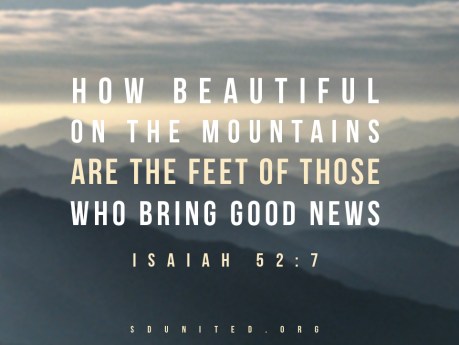
These days, I’ve been creating graphics to highlight Scripture verses and quotes (which I believe is more effective than simply putting the words onto a blank screen):

Beautiful feet

I’ve been inspired by several friends who have made a daily commitment to developing their God-given creativity, whether it’s through drawing, photography, or writing. While I don’t have the time (read: discipline) to commit daily to this practice, I’ve been interested in handlettered art.

A few sources of inspiration: You’ve probably seen the work of Dana Tanamachi, or at least pale imitations of her work on Pinterest. I also love the work by the designers and artists who display their work on Typographic Verses.

With that, I’ve been trying my (ahem) hand at handlettering. The process of conceptualizing, sketching, erasing, re-drawing, editing, and final production teaches me so much not only about creativity & art, but also writing, preaching, and communication.

Sitting quietly in front of a blank page, listening, is becoming a spiritual discipline for me.

Here’s my latest — I certainly don’t do it justice, but this is one of my favorite passages for how God deals with our sin. There’s something so vivid about God heaving our sins into the deepest of oceans, to be remembered no longer:

Handlettering - Cast their sins

After our church services on Sunday, I spoke with a father whose son recently suffered an unexpected (and unjust) setback in his future career path.

This father shared with me how he counseled his son through the disappointment.

He, too, had suffered a similar setback early in his career. However, instead of letting it derail his sense of purpose, he rolled with it, bloomed where he was planted, and continue to seek God faithfully. His words were so wise:

“Son, your career is a means to glorify God. If He shuts one door, then you’ll be able to glorify Him through another. The most important thing is to honor God with your whole life.”

As a dad, I want my daughter to be resilient, to be able to bounce back from the inevitable disappointments and frustrations that will come her way in this broken world. I want her to fight the temptation to walk away or give up when life hurts. The truth is, I know I have to model this kind of holy resilience for her to catch it.

Friends, don’t give up. 

Light will break through this night. The fog will be lifted by the morning light.

The cross of Jesus Christ could have been the worst kind of disappointment: when hopes & dreams we had dared not speak were dashed apart in betrayal, darkness, and shame.

Instead, from the shipwreck of our lives, we see how far God will go in relentless pursuit of His beloved people. The cross tells a simple story: God has not given up on you.

And when Jesus emerged from the grave on that first Easter morning, we hear God’s voice again: You are alive and free.

You are not bound by sin and brokenness and death. God has hopes and dreams for you. Let this be your story and your song.

Wake up O sleeper