Archives for category: health

Does My Lunch Tell My Story?

Recently, I’ve spent more time than usual considering Asian American identity. The great comments on my recent post about the upcoming San Diego Asian American leadership gathering and its ethos and my daughter’s time in her predominantly white preschool have propelled much of this thinking.

Kathy, over at More Than Serving Tea, shares a great family story about her kids bringing Rice & Seaweed in the Thermos to school for lunch and the stress & worry that created for her. My daughter usually eats lunch at home, but she recently began to attend a “lunch bunch” program at her church. It crushed me to hear her say that she didn’t want to bring chicken and rice to school because she didn’t want the other kids to think she wasn’t “English.” It reminded me of my utter dismay at having my Caucasian friends discover the crazy varieties of kimchi my mom had bottled up around the house.

In Between Two Worlds

We have always done our best to help our daughter understand that she is Asian and American, and that is exactly how God created her to be. We have tried to foster in her heart a confidence in God and in her God-given identity. Since she’s growing up as an American girl, we work hard to show her the benefits of being Asian as well — that it is part of what makes her unique and fun, and that she doesn’t have to blend in with the crowd. Both my wife and I struggled with our sense of belonging and worth during our formative years and we want our daughter to enjoy being herself. We want to walk beside her, lead her, and listen to what’s happening in her heart — in ways that our parents, though they wanted to, could not have.

Two Kinds of Hatred

From what I’ve seen and experienced, the Asian American struggle with identity often breaks down into two kinds of hatred: hatred of Asian culture, and hatred of self. While these two struggles certainly interact and feed into one another, I believe we can approach them in slightly different ways.

Elderj wrote a great piece about Self Hatred & the Gospel in which he identifies the self-hatred that lies just beneath the surface of the critiques Korean Americans have against their churches and their culture. Although I always enforced the “take off your shoes before entering my house” rule among my non-Asian friends growing up (oh, the controversy!), I often struggled with the mysterious rules & regulations of my Asian heritage. So what if I was the oldest son of the oldest son in his family? Why did my parents think my friends were rude for not identifying themselves on the phone before asking for me? Even for my AA friends who grew up with more detailed explanations of their Asian heritage and among more Asian people, there was still a profound disconnect — even disdain — for many of their Asian customs & practices.

On a deeper level, I knew many AA friends who simply hated who they were. In what would have been humorous in another context, I learned the word “loathe” in fifth grade when an older friend explained how he “loathed” being Korean — I was confused, because it sounded like he “loved” being Korean, when I knew full well that he felt quite the opposite. He explained to me that it was more than hatred, but that he was disgusted with his Korean-ness. Whether it is the overt acts of racism against them or the undercurrent of being a permanent outsider, many Asian Americans turn their hurt, sorrow and frustration against themselves.

The Image of God

Dealing with the hatred of Asian culture is a relatively straightforward proposition. It might be as simple as pointing out the many positive aspects of our cultures — the awesome eats, greater sense of connectedness, commitment to family, sweet Samsung flat screen TVs (you know, the really important stuff). This struggle might create the opportunity to talk about what it means to be unique, to see how different cultures shape and inform who we are (for better and for worse) — hopefully, to live in the best of both worlds.

The hatred of self is a much deeper issue. Ultimately, I believe this is a profoundly theological question — not just one of sin and death and salvation, but of redemption. Our churches do a pretty good job of driving home the point that we are wretched sinners, desperately in need of mercy — worms incapable of any good thing. I’m being hyperbolic, but not by much. Just last week, a recent college grad at our church shared about how his “discipleship” program in college consisted mostly of his “discipler” condemning and guilt-tripping him. It’s not too hard to convince people who already hate themselves that they are awful, disgusting sinners.

Please hear me: we are all guilty. Sin has left the world, and our souls, utterly broken. But Jesus tells a story of rescue and redemption. Perhaps in our desperation for orthodoxy, we neglect to tell the story of the imago dei — that we are all made in the image of God. That this imago dei story was first and that Christ’s victory over sin and death creates the possibility of restoration. Perhaps a more robust theology will allow us to see that God purposefully and joyfully created us as Asian Americans. Instead of holding up “whiteness” as the standard and ultimate goal, perhaps theology can actually be useful to help us break free from this captivity.

I love that, when Jesus finally greets us on that day, He doesn’t demand that we give up our heritage. In fact, the scenes of worship and adoration in Revelation become even more glorious when we begin to hear the distinct languages and see the unique faces of all of those gathered around the Lamb.
As Eugene Cho wrote recently in southern california is burning, it can be hard to actually enter into another person’s experience. Even for us, right in the midst of the firestorm and its aftermath here in SD, there can be a strange disconnect. Like others around the nation, we’ve been watching the firestorm from the television. As Shane Hipps comments, “The screen always wins.” I mean, we are here and it wasn’t even a week ago that we were grabbing only the essentials as we evacuated through the smoke and sirens early in the morning and yet watching the constant news feed has a strange, dulling effect. The sense of being “informed” creates a false sense of understanding, which can easily create a barrier to actually engaging the reality of individual people’s lives.

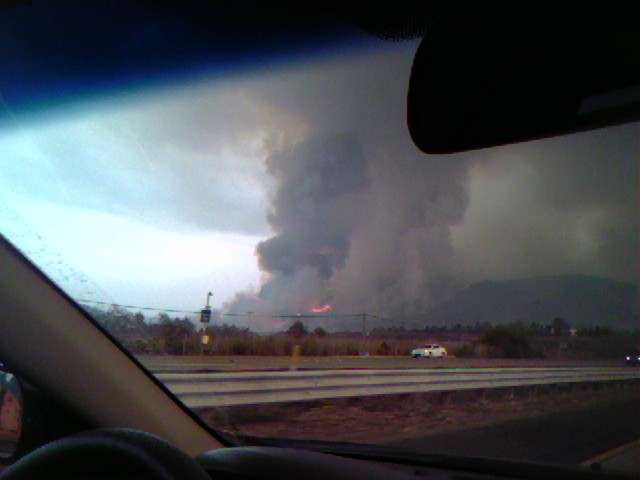
Sometimes it takes just being there to feel and understand it. During our return back to San Diego, we drove past the Camp Pendleton fires which created a menacing black cloud through which we had to drive. This junky cell phone photo (which, not to worry, were taken by my wife from the passenger seat!) shows how powerful one small brush fire can be — the hills and valleys in the immediate vicinity were, at the time, pretty well ablaze, so you can imagine what the larger scene looked like:

fire-4.jpg

* * * * *

However, more than just driving by, what brought home the impact of these fires for me was helping a church family try to deal with the aftermath. This particular family lives in one of the hard-hit neighborhoods and were just able to re-enter today. After much worrying and wondering, they were relieved to find their home in good condition. Their neighbor five houses, down, however, was not so fortunate:
five-doors-down.jpg

I have heard about the random nature of fires — one house will be perfectly fine, the next completely leveled. But it is an altogether different experience to see it with my own eyes. We spent most of the afternoon trying to clean up the ash and soot that covered most of everything and to try to make their place livable again.

On Monday, while were still greeting evacuees at our church, a stranger wandered into our education building. After talking for a bit, finding out some of his story and giving him some bus fare, he said (regarding the wildfires), “You know, people call these kinds of things ‘acts of God.'” I told him I didn’t think that was an accurate description of what was happening. As much as we’re all grateful that God has spared our homes, can we really say that we out-prayed or received more favor from God than those who lost their homes? I don’t think this is a straightforward one-to-one proposition — otherwise, we’d all end up losing our places, wouldn’t we?

* * * * *

After cleaning the front of the house and the garage, we moved to the backyard — which, if we didn’t realize it before, definitely put into perspective how close they came to losing their house. One family member saw the garden hose in the back and didn’t remember leaving it out, and then we saw this burnt out palm tree, not even ten feet from the house:

burned-palm-tree.jpg

We could only guess that either a firefighter or neighbor who stayed behind saw the burning palm tree and doused the flames with the garden hose. Just beyond the white fence is the ravine through which the fire cut a brutal path — embers kicked up from the Santa Ana winds must have caught the house five doors down.

However, the street just across the gulch was hit much harder. I passed house after house that looked as if some angry, mythic giant had just stomped on them; but there was the same randomness — one house was hit, the next three were fine, and then two in a row were gone. News crews were out in full force (I saw at least three), chronicling the heartbreak of families trying to salvage whatever they could.

next-block.jpg

* * * * *

My daughter attends the preschool of a church in this community in which 57 families lost their homes. Tonight, they hosted a gathering of worship, prayer and sharing. It did our hearts good to stand with others in our community who have lost it all and yet can say, “We are survivors; God is with us” as we did as a modified benediction today. Reading Scripture together, seeking God and interceding on behalf of others, sitting together in silence. The old hymn, “Great Is Thy Faithfulness” came together with a new resonance tonight.

We realized tonight that, in our longing for connection, community is not going to come to us — we have to pursue it, build it wherever we are. If you are in the San Diego area, there are plenty of people in need. Some need help sifting through the rubble, some might need special expertise navigating the maze of FEMA and insurance, and some might just need you to listen to their stories and weep with them. Let’s be the body of Christ to a hurting world. Or, as Donald Miller writes, followers of Christ are called to live “as if something was broken in the world and we were supposed to hold our palms against the wound.”

After an arduous and extremely surreal couple of days on the run, we are finally back home.

Apart from the ash covering the stairs and landing in front of our place, things are looking pretty normal around here. However, that sigh of relief that I breathed upon seeing our apartment complex still standing was followed quickly by a prayer for the thousands who have now found themselves homeless. Or, perhaps even worse, still do not know the status of their place — as is the case with one of our church families.

* * * * *

Today, we awoke at my father-in-law’s place before six in the morning to the sound of sirens wailing in the near distance. After making sure things were settled down at church on Monday, we drove straight up to Orange County to my father-in-law’s place because they were uncomfortably close to the Santiago Fire (apparently — inexplicably — the result of arson). We wanted to makes sure we were there to help them evacuate, if necessary. After all, our church community has one another, but we are the only family around to help my father-in-law.

It was the sound of police sirens that first alerted us to the evacuation up in Rancho Bernardo, so when we heard them in OC my heart was pounding as I raced to the computer to find out what was happening. Unfortunately, they are still using a dial-up connection to the internet. I was not aware that people still used dial-up. This was, perhaps, a divine test of my patience, as pages that take more than five seconds or so to load usually drive me nuts. After what seemed like an eternity, I was finally able to locate the number to the local sheriff and to the Santiago Fire hotline. I received assurances from both that the danger was not imminent, and there were no evacuations for this community. This, despite the fact that we could see the flames from the second-floor balcony and ash was beginning to fall like snow.

We spent the remainder of the morning calling every church family we could, making sure everyone was alright. Throughout the morning, we kept receiving the good report that many were able to repopulate their homes. We also kept in contact with the local sheriff’s department and fire hotline to make sure there were no local evacuations. After receiving assurances that things were stabilizing around OC, we made the trek down the 5 freeway back to San Diego. We passed through the area of the Camp Pendleton fires, which had caused intermittent closings of the 5 throughout the morning. Though this fire was “small” in comparison to some of the beasts that have been raging across Southern California, there is something extremely emotional about seeing a wildfire up close. I’m just glad that our daughter was sleeping as we passed through the hellish, billowing smoke that blackened the afternoon sky.

* * * * *

Something cynical inside me wants to rebel against the constant media barrage and emotional manipulation — the Kenny G tracks playing over photo montages of people weeping in front of their burning homes, the breathless “on the scene” reporters, the grandstanding talking heads using the crisis to yammer on about their pet political stance.

Firefighters battling Southern California blazes, from SignOnSanDiego.comAnd yet, there is no denying some of what has unfortunately almost become cliche during these kinds of tragedies. There can be no doubt about the heroism of the hundreds of firefighters who have fought these blazes day and night. With hardly enough time to rest for a moment, these brave men & women have put their lives on the line to save lives and homes. One family lost their home, but firefighters found a safe moment to dash into the home and grab some photos before all was lost. As one firefighter said during an interview, “Every home is our home.”

I don’t mean to sound gratuitous in saying this (I never use this as sermon material), but I am reminded of 9/11. We were on the ragged edge of disaster there as well — living just across the bridge to the city in Palisades Park. We have heard it so many times, but when everyone else was running away from the burning towers hundreds of firefighters were running toward them. And we have seen the same selfless heroism on display this week.

In fact, the reason we felt secure in leaving my father-in-law in Orange County was because of the incredible work of the understaffed firefighters to make a stand against the Santiago Fire. Almost on sheer will it seems, they have beaten back the beast.

* * * * *

The crazed dash to evacuate our place really put things into perspective for us in terms of what is really important. I was really pleased to receive my Junky Car Club membership in the mail a couple of weeks ago, but I wasn’t quite ready to live out their motto, “Learning to live with less so that we can give more” by losing everything we own to the firestorm. However, amidst the sirens and smoke, ash and adrenaline as we evacuated the blaze, what really mattered was getting our family out of there.

I am so thankful for my wife and daughter. My wife was the first one to bring panicked church members together to pray — and not only for the winds to cease and the fire to fall back, but for our community to seek God’s heart. During the non-stop news reports, our four-year old daughter kept asking if our place burned down. We tried explaining that we hoped things were fine, but even if we lost our place that God would still take care of us. Finally, we realized she was concerned that her dolls would be hurt and that she was not there to help them escape. Today, we heard a story on the radio about a man who bought out the local big box retailer for children’s backpacks. Our daughter asked us why he did that, and we explained that there were lots of kids at the stadium who lost all of their stuff in the fires. Her eyes lit up and she said earnestly, “I have toys at home. I can share with them!”

* * * * *

There is an uneasy calm as things get back to “normal” around here. Will tomorrow bring another phone call about a friend who lost a home? When can we stop wearing masks outside? Can the talking heads and pundits wait until at least next week before launching their politicized tirades against whomever?

I am worn out. And, even in saying that, I feel guilty because I know there are many others just down the street who do not have luxury of typing those words in the comfort of their home. All I can do is join the psalmist and pray:

The Lord is my rock, my fortress and my deliverer;
my God is my rock, in whom I take refuge,
my shield and the horn of my salvation, my stronghold.

Thank you for your prayer, concern and offers of shelter and help — you have been God’s tangible grace to our family. May God continue to have mercy on all of us here.

Thank you, everyone, for your prayers.  I think they might be the one thing sustaining us right now.  

I am writing from Orange County. My wife is an amazing trooper — she drove most of the four-hour drive through bumper-to-bumper traffic up from San Diego, while I spent most of the trip vomiting (we think it was probably due to smoke inhalation).   Our family is still safe, but all we have right now is what we could cram into the car during the mad dash to evacuate our place.  We are hearing reports that our apartment is still standing, but at literally the next stop light up the road the fire departement is not allowing people to pass because of the continuing fire danger.

We spent most of yesterday at church helping out church families who were, and still are, under mandatory evacuation from their Rancho Bernardo homes.  Just to give you an idea of the sheer destructive force of these fires,  here is the preliminary report of homes lost in the Rancho Bernardo neighborhood alone  (although, because so many residents have been trying to access the site, you might want to wait a couple of days before checking it out so that there is more bandwidth for those affected).

There are wildfires raging in Orange County as well, which is what brought us to my father-in-law’s place.  If they need to evacuate (which is still a realistic possibility), then we wanted to be available to help them.  Things seem relatively stable here, so if we get word that we can return to our homes then we will be back in SD tomorrow.

Our students are frightened.  I can’t tell you how many of them received phone calls from their friends, weeping because they had already lost their homes.  One of my ninth-graders, in fact, was the first one to inform her friend that she had lost her home after seeing their address listed during the continuous television coverage.  How do you deal with that? We prayed together and tried our best, with racing hearts, to reassure and comfort them.

Worse still, many of them live in the neighborhoods that were hit hardest.  One of my youth group teachers left her house with only her family and the clothes on their back when the police arrived at their house at four in the morning, urgently telling them to evacuate because the fire was already destroying their neighborhood. 

We’re still waiting to find out which homes are still standing.  It’s the not knowing that is the worst part.  Yes, yes — it’s just stuff; but, at the same time, these homes are safe havens filled with memories and it has been utterly crushing to just sit and wait and watch while San Diego burns. 

Over half a million people have been evacuated.  There are over 20,000 people taking refuge at Qualcomm Stadium.  The fires continue to rage across thousands of acres and turn countless lives upside-down. View the San Diego Tribune’s interactive map to get a sense of the vast scope of devastation in the San Diego area.

Somehow, we know that God is bigger than all of this — but, from down in the soot and ash, fear and despair, it is so hard to trust.  We treasure your continued prayers for all of us here.

I think a good part of what I’ve been struggling with these days comes from missing friendship. I’m not trying to write a sad song here — I definitely have friends and acquaintances and, more importantly, a beautiful, supportive family. But, in the last couple of years since we moved out to California, I find myself missing the community we had on the East Coast more & more. My seminary days were tumultuous and difficult, but I treasure the friendships we forged there.

David Park recently shared some great thoughts about accountability, authenticity and friendship. As I read, I was reminded of the “accountability” group I was a part of during my seminary days. We would gather every week to share about our sins & struggles and to pray for one another. However, all of us being Asian American, I think we were pretty guarded. There were several things working against sharing what was genuinely in our hearts — we didn’t all know each other that well, we were all raised in an honor/shame culture, we were all men and the group was little bit too large to allow everyone to share in a reasonable amount of time.

Now, don’t get me wrong — I really valued, and still value, those “official” gatherings. But those kinds of accountability groups, as Joseph Myers points out in Organic Community, have a tendency to focus on the negative. As he puts it, “There is such an underlying expectation of failure” when all we do is keep “account” of our sin & failure. Even my personality (introverted, and shy to boot) works against the effectiveness in my life of this kind of gathering.

I found that simply sharing life together with these same friends set me on a true path. Laughter and joy keep my heart in order and provide perspective, keeping me from getting too wrapped up in my own problems. Actually being there together builds more trust in my heart than going around in a circle and sharing coded prayer requests with people who are essentially strangers.  And it is being there together that creates an environment where, from time to time, deep sharing can occur.

I suppose this is all tied into what I am feeling about my future in the church. I am tired of being part of commuter communities, where the sheer physical distance makes it virtually impossible to build deep friendships. I’ll probably say more on the problems of commuter churches some other time but, seriously, can we develop meaningful relationships in a couple of hours a week — much of which is spent sitting in relative physical proximity but never really engaged with each other? Or can a people’s minds really be there for someone else sharing late into the night at a weekly small group gathering if they know they have a twenty or thirty mile drive in order to get home after everything is done?

Maybe I just need a friend to go to the batting cages, or some indie rock shows, with me. It would relieve a great burden from my wife — who is an extraordinary listener, but who is burdened with the entirety of my worry, stress and frustration — and from me.